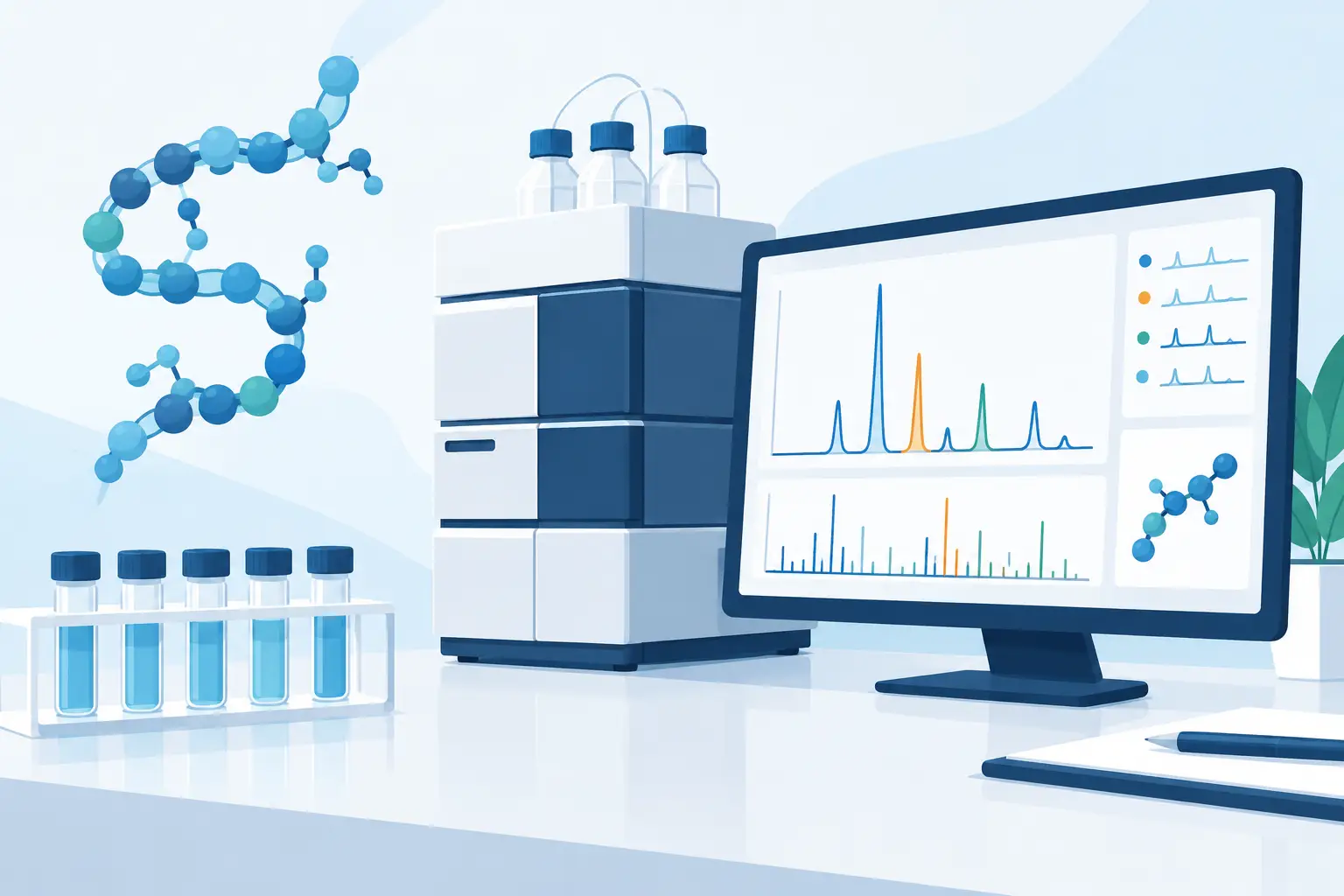
A reported purity figure is only the beginning. Peptide impurity profiling determines what sits behind that number: whether the expected peptide is present at the correct mass, which related species remain, and whether the analytical record supports confident research use. For laboratory buyers, this is the difference between a product claim and documented evidence.
A high-purity lyophilised peptide may still contain chemically meaningful low-level components. Some arise during solid-phase peptide synthesis. Others develop during cleavage, purification, drying, storage or transport. Their relevance depends on the peptide sequence, intended research method, concentration, solvent system and required reproducibility. No shortcuts. No compromises.
Peptide impurity profiling is the analytical characterisation of components other than the intended peptide within a material. It does not rely on a single test. A defensible profile brings together chromatographic separation, mass confirmation and controlled batch documentation.
The central question is simple: does the analytical evidence support the stated identity and purity of this specific batch? In practice, answering it requires more than seeing one prominent chromatographic peak.
Reverse-phase HPLC is typically the primary tool for estimating chromatographic purity. It separates compounds according to their interaction with the stationary phase and mobile phase gradient. A well-resolved chromatogram can reveal the principal peptide peak alongside visible related peaks, allowing the laboratory to calculate area percentage under defined conditions.
Mass spectrometry supplies a different but essential layer of evidence. It assesses molecular mass and charge-state distribution, helping confirm that the principal HPLC peak corresponds to the expected analyte. HPLC can show separation; mass spectrometry helps establish identity. Neither should be treated as a substitute for the other.
Peptides are assembled through repeated coupling and deprotection steps. Each step has a potential failure mode, particularly as sequence length, hydrophobicity and structural complexity increase. The final material may contain a small population of closely related compounds that differ in mass, retention time or both.
Common process-related impurities include deletion sequences, where an amino acid was not incorporated; truncated sequences; incompletely deprotected residues; and sequences altered by side reactions. Oxidation, deamidation and hydrolysis can also occur, either during manufacture or later through unsuitable storage conditions. A disulphide-containing peptide introduces further variables because incorrect pairing or incomplete oxidation may generate related species.
Not every impurity carries the same analytical significance. A deletion sequence can sit very close to the target peak and require carefully selected chromatography to resolve it. Oxidised forms may be expected at trace level for susceptible sequences, yet an increasing oxidised peak across stability testing can indicate a handling or storage concern. The profile must therefore be interpreted in the context of the compound and batch history, not as a generic checklist.
Residual processing materials may also be relevant. Depending on the manufacturing route, analytical controls can extend beyond peptide-related substances to residual solvents, counterions, reagents or water content. These tests answer different questions from HPLC purity. A single percentage cannot represent every attribute of material quality.
HPLC purity is often expressed as the percentage area of the main chromatographic peak relative to total integrated peaks. It is a valuable comparator when the method, integration rules and detection wavelength are appropriate. It is not an absolute declaration that every molecule in the vial has been individually identified.
Detector response varies between compounds. A UV chromatogram also depends on the selected wavelength, baseline treatment, gradient, column chemistry and integration threshold. Minor peaks can be concealed by poor resolution, while aggressive integration settings can either exaggerate noise or omit genuine low-level components.
For this reason, a purity result should be read alongside the chromatogram itself. Buyers should expect to see whether the main peak is symmetrical, whether neighbouring peaks are resolved, and whether the report identifies the method conditions used. A claimed result of 99% or greater has far more value when it is connected to a legible, batch-specific analytical record.
There is also a practical distinction between analytical purity and content. A vial can show a clean chromatographic profile yet contain less peptide than expected if fill accuracy, moisture uptake, salt form or other factors are not properly controlled. Research-grade quality depends on the complete control picture: correct identity, defined purity, appropriate formulation and traceable handling.
The strongest quality decisions use complementary methods because each technique has limitations. This is known as orthogonal analysis: applying methods that measure different properties of the same material.
A suitable HPLC or UHPLC method separates the principal peptide from related substances. Method selection matters. A short, highly polar peptide may need conditions very different from a longer hydrophobic sequence. If the method does not challenge likely impurities, apparent purity can overstate actual separation.
Electrospray mass spectrometry commonly provides molecular-weight confirmation for peptides. The resulting charge envelope should deconvolute to a mass consistent with the expected sequence and defined form. It can also reveal mass shifts that point to oxidation, deamidation, adduct formation or residual protecting-group-related species.
Mass confirmation has boundaries. Isobaric species can share the same nominal mass, and a mass result alone does not demonstrate chromatographic homogeneity. When a deeper investigation is required, laboratories may use tandem mass spectrometry, peptide mapping or other sequence-informed techniques to assign a specific impurity.
Analytical results only have purchasing value when they can be tied to the exact batch supplied. A third-party Certificate of Analysis should identify the material, batch or lot, test methods, acceptance results and date of issue. It should not be a generic certificate reused across multiple batches.
Batch-level traceability creates continuity from sourcing through verification and dispatch. For lyophilised peptides, documented handling is especially relevant because temperature exposure, moisture and repeated unnecessary handling can alter the material before it reaches the research setting.
A Certificate of Analysis is evidence, not decoration. Start by checking that the compound name, batch identifier and stated format match the item being ordered. Then assess whether the reported tests answer the questions relevant to your work.
For most research buyers, the minimum analytical foundation is a purity assay by HPLC and identity confirmation by mass spectrometry. A chromatogram provides useful context, particularly where a high purity specification is claimed. For methods sensitive to trace related substances, residual solvents, water content, counterion composition or microbial control may also matter. The appropriate package depends on the peptide and application.
Be cautious with vague statements such as “laboratory tested” or “high purity” when no method, result or batch reference is available. Equally, do not assume that a more detailed certificate automatically proves fitness for every experimental protocol. The required impurity threshold depends on what is being measured. Exploratory screening, quantitative method development and highly controlled comparative work can demand different levels of characterisation.
A disciplined supplier should be able to show a coherent chain of evidence rather than asking the buyer to infer quality from packaging or marketing language. At G.O.A.T Peptides, the standard is clear: independently verified analytical documentation, defined purity targets and traceable batch control for every vial.
An acceptable release profile is not permanent protection against degradation. Lyophilised formulation generally supports stability, but it does not make a peptide indifferent to heat, humidity, light or poor reconstitution practice. Once reconstituted, the solvent choice, concentration, pH and storage interval can affect degradation rate.
Use the supplied handling guidance and maintain a clear laboratory record of receipt, storage conditions, reconstitution details and aliquoting. Avoid repeated freeze-thaw cycles where the material and protocol make that a concern. If a study spans an extended period or requires tight comparability, retaining a reference aliquot and reviewing post-storage analytical data may be justified.
The principle is straightforward: release testing verifies the material at release, while controlled handling preserves the relevance of that verification.
Price per vial is easy to compare. Analytical confidence is harder, because it is built from information that must agree: a credible chromatogram, expected mass, defined specification, traceable batch number and controlled fulfilment. Where any link is missing, the true cost may appear later as inconsistent data, repeated experiments or uncertain interpretation.
Peptide impurity profiling does not promise perfection. It provides a measured account of the material actually supplied and the limits of what has been tested. That transparency is the useful standard: buy evidence matched to the sensitivity of the research, retain the batch record, and treat every vial as a controlled laboratory material.